
The origins of the skateboard are generally associated with California surfers seeking to recreate the sensation of gliding when the ocean was calm. Using wooden planks or crates fitted with roller-skate wheels, they set out to conquer the “concrete waves.”
At first glance, a skateboard is remarkably simple: a deck, two trucks, and four wheels. Its current form, however, is the result of several decades of technical innovation, some of which have been the subject of landmark patents.
Its history also illustrates an important reality in patents: the innovations that transform a market are not always those that leave the clearest mark in patent records. Conversely, a targeted improvement protected by carefully drafted claims can have a considerable impact on the evolution of a product.
The Deck: The Decisive Effect of the Kicktail
From Early Boards to Boyden’s Patent
According to historical accounts, around 1957, Alf Jensen created and commercialized a steel-wheeled skateboard known as the “Bun Board” in Hermosa Beach, California. However, no patent was specifically associated with it. Around 1959, Roller Derby began commercially producing skateboards, a development often characterized as an early instance of large-scale skateboard manufacturing.
That same year, Albert C. Boyden filed a patent application for a “Child’s Coaster.” His system used triangular wooden blocks beneath the deck to provide an initial form of tilting and steering. The resulting U.S. Patent No. 3,023,022, issued in 1962, is often cited among the first patents devoted to the skateboard. Later skateboard histories associate the Boyden design with a product reportedly marketed as the “Humco Surfer” around 1963.
Along Comes Stevenson’s Patent of the Kicktail
One of the most influential patents relating to the shape of the deck, however, remains that of Richard Lawrence Stevenson, founder of Makaha Skateboards. Issued in 1971, U.S. Patent No. 3,565,454 describes, among other things, a deck with a raised rear end: the kicktail.
This modification allowed the skateboarder to apply pressure behind the rear axle, lift the front of the deck and perform more complex manoeuvres. It helped transform the skateboard from a basic means of transportation into a form of equipment for performing technical tricks.
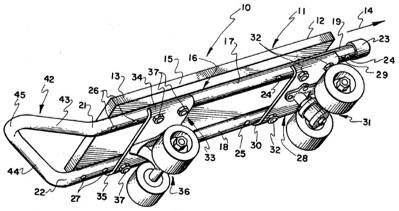
US 3,565,454
Although Stevenson’s patent also depicted and described a deck with two kicktails, it did not specifically cover the “popsicle” shape of modern-day decks. This essentially symmetrical shape seems to have resulted from the cumulative evolution of the board’s overall form, rather than being the subject of a single foundational patent.
The Wheels: When Commercial Innovation Goes Beyond the Patent
Historical accounts commonly describe early metal wheels as rigid and noisy, and as having little grip, while clay or composite wheels, although providing a different ride, remained prone to slipping, chipping or breaking.
In this context, the introduction and broad commercialization of polyurethane wheels represented an important turning point in skateboard performance.
The Rise of Polyurethane Wheels
Around 1970, Frank Nasworthy encountered polyurethane roller-skate wheels manufactured by Creative Urethanes and recognized their potential for skateboards because of the greater grip they offered. He subsequently established Cadillac Wheels, adapted the technology to skateboards, and began marketing polyurethane skateboard wheels around 1972.
Polyurethane wheels then gradually replaced clay and metal wheels. However, the broad use of polyurethane for skateboard wheels does not appear to have originated in a foundational patent, as polyurethane wheels were already used in other contexts. Nasworthy’s principal contribution, therefore, seems to have been the adaptation, promotion and distribution of polyurethane wheels for skateboards.
Powell’s Patent and the Double Radial Wheel
In 1978, George Powell, cofounder of Powell-Peralta, secured U.S. Patent No. 4,128,254 for a wheel with a double radius of curvature, meaning that it was rounded on both sides. This geometry was intended to facilitate rolling over obstacles, improve turning and reduce uneven wear. This patent documents an early effort to optimize wheel-edge geometry in response to performance considerations that remain relevant to modern skateboard-wheel design, particularly those intended for street skateboarding.
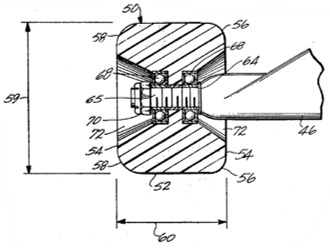
US 4,128,254
Trucks: From Roller Skates to Surfskates
The first skateboard trucks were largely inspired by mechanisms used in roller skates. According to historical accounts, the greater speed and grip made possible by polyurethane wheels also increased the demand for more stable and durable truck designs.
Bostick’s Patent and Early Steering Mechanisms
U.S. Patent No. 3,235,282, issued in 1966 to Louis D. Bostick, describes an articulated truck system using rubber shock absorbers, also known as bushings. It represents one of the earliest documented examples of a steering system specific to skateboards, capable of responding to the deck’s tilt and returning to a neutral position.
The Tracker Fultrack: Innovation Without an Identified Foundational Patent
Company histories and retrospective accounts report that the “Tracker Fultrack,” a wide and stable truck, was introduced around 1975 by Dave Dominy, Larry Balma and Gary Dodds through the company Tracker, marking an important turning point in truck technology.
Specifically, the Tracker Fultrack’s design combined a hanger comprising a transverse axle and pivot with a baseplate comprising a pivot cup and kingpin. This configuration improved high-speed stability and introduced a four-hole baseplate that remains widely used today.
However, no patent specifically claiming the core “Tracker Fultrack” configuration has been identified. In the absence of a patent specifically directed to its core configuration, comparable geometries could be adopted more broadly, subject to any other applicable rights. The company nevertheless protected certain truck-related components, including the “Tracker Coper,” a plastic shield designed to protect the hanger during sliding tricks, which was covered by U.S. Patent No. 4,214,768, issued in 1980.
The Split Axle: Protecting a Geometry Designed for Slalom
Conversely, Michael P. Williams and William H. Brawner chose to protect their “Split Axle” mechanism and secured U.S. Patent No. 4,109,925 in 1978. This design replaced the continuous transverse axle with two half-axles arranged in an angular geometry, increasing the truck’s responsiveness and reducing its turning radius. The resulting manoeuvrability was particularly suited to slalom, a discipline that was rapidly gaining popularity.
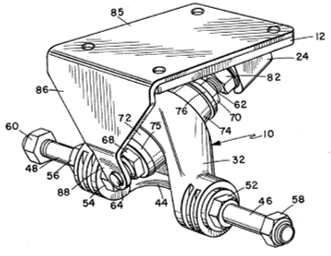
US 4,109,925
From Manufacturing Know-How to Specialized Trucks
As the general architecture of skateboard trucks became more established, manufacturers increasingly differentiated their products through manufacturing know-how and incremental refinements that were not necessarily reflected in the patent record.
In fact, during the 1980s, innovation relied more heavily on casting processes, metallurgical choices, manufacturing tolerances and subtle geometric variations, which were most likely maintained as trade secrets.
Subsequent innovations supported the emergence of more specialized disciplines. U.S. Patent No. 5,263,725, issued in 1993 to Daniel Gesmer and Max Haug, replaced traditional bushings with mechanical springs to control steering and the hanger’s return to centre, an architecture associated with the development of the modern longboard.
U.S. Patent No. 6,443,471, issued in 2002 for an invention developed by Rodney Mullen, sought to reduce lateral hanger play and contact between the wheels and the deck, also known as “wheel bite,” without compromising the responsiveness required for street skateboarding.
Finally, U.S. Patent No. 6,793,224, issued in 2004 to Neil Stratton, describes a double-pivot truck with an adjustable spring, which contributed to the growth of surfskating and to propulsion through lateral movements, also known as “pumping.”
These examples illustrate how the same component may evolve differently according to the particular requirements of each discipline.
Five Lessons from Skateboard History for Patent Strategy
From the above, we have drawn five lessons on the importance of patents, and intellectual property in general, for developing and commercializing a product.
1. A Targeted Improvement Can Have Significant Value
The kicktail demonstrates that a seemingly limited modification can transform how a product is used. The value of an invention depends less on its complexity than on the technical problem it solves and the new functions it makes possible.
2. The Scope of a Patent Depends on Its Claims
A patent entitled “Skateboard” does not grant a monopoly over all skateboards. The claims primarily define the legal scope of protection in light of the description, the prior art, and, depending on the jurisdiction, the prosecution history. The title and drawings alone are therefore insufficient to determine what the patent actually protects.
3. Commercial Innovation Is Not the Same as a Patented Invention
Cadillac Wheels shows how a company can transform a market by adapting and distributing an existing technology, even without a dominant foundational patent. Commercial success, however, is not a substitute for a patentability analysis, and the absence of a dominant patent does not guarantee freedom to operate.
4. A Strategy May Combine Several Forms of Protection
Depending on the product and target jurisdictions, an intellectual property strategy may combine:
- patents for functional features;
- industrial designs for appearance;
- trademarks for commercial identity; and
- trade secrets for certain processes or know-how.
These rights are complementary and should be selected according to the market, the desired duration of the advantage, and the anticipated timing of any disclosure.
5. Innovation Continues After the First Patent
Double kicktails, double-radius wheels, spring-loaded trucks, and surfskate systems show that a technology can give rise to several generations of improvements. A patent strategy should, therefore, evolve with the product, its uses, and the market, ideally before any public disclosure.
Conclusion on Patents: A Strategic Tool, Not the Complete Story
Most, if not all, landmark historical skateboard patents are now expired, and a great deal of their technical teachings is in the public domain. However, this does not mean that every feature of a modern product may be freely exploited: more recent rights may protect improvements, specific configurations, the product’s appearance, or its commercial identity.
For an innovative company, the objective is not necessarily to patent everything, but to determine which innovations should be protected, through which mechanisms (e.g., using intellectual property rights other than patents), at what time, and in which jurisdictions, while considering third-party rights and future generations of the product. This analysis should ideally take place before any public disclosure or commercialization.
Lavery’s intellectual property team, including its patent agents, assists companies in defining innovations; assessing patentability; developing filing strategies; drafting and prosecuting patent applications in Canada and abroad; analyzing third-party rights; and strategically managing portfolios.
Our approach at Lavery seeks to make intellectual property a genuine business lever by aligning the protection sought with commercial objectives, target markets, and anticipated product development.
References:
- Albert C. Boyden, Child’s Coaster, U.S. Patent No. 3,023,022 (issued February 27, 1962).
- Louis D. Bostick, Skate board provided with longitudinally adjustable wheel carriage units, U.S. Patent No. 3,235,282 (issued February 15, 1966).
- Richard Lawrence Stevenson, Skateboard with inclined foot-depressible lever, U.S. Patent No. 3,565,454 (issued February 23, 1971).
- Michael P. Williams and William H. Brawner, Skateboard chassis, U.S. Patent No. 4,109,925 (issued August 29, 1978).
- George A. Powell, Skateboard wheels, U.S. Patent No. 4,128,254 (issued December 5, 1978).
- David A. Dominy and Gary M. Dodds, Shield for skateboard truck axle housing, U.S. Patent No. 4,214,768 (issued July 29, 1980).
- Daniel Gesmer and Max Haug, Skateboard truck assembly, U.S. Patent No. 5,263,725 (issued November 23, 1993).
- Rodney Mullen, Skateboard truck assembly, U.S. Patent No. 6,443,471 (issued September 3, 2002).
- Neil Stratton, Truck for skateboards, U.S. Patent No. 6,793,224 (issued September 21, 2004).
- Get Rad! The Evolution of the Skateboard Deck | Evolution: Education and Outreach | Springer Nature Link
- The history of skateboarding: how the sport has grown
- How Have Skateboard's Evolved? All You Need to Know
- History Of Skateboard Wheels (Explained) | Concrete Waves
- A Brief History of Tracker Trucks — Tracker History