
Each Fashion Week marks a period of high visibility for the brands in the fashion industry, but it also exposes them to increased risks of copying, counterfeiting, and unauthorized uses. Patents, industrial designs, trademarks, and copyright can offer complementary protection, provided action is taken at the right time.
Why Fashion Week increases the risks of copying and counterfeiting
In the age of social media, Fashion Week represents much more than simple runway shows. As soon as they are unveiled on the catwalk, new collections circulate quickly in the media and can go viral within hours.
Although this acceleration of the visibility cycle contributes to the excitement surrounding the most sought-after clothing items, it also exposes designers to an increased risk of reproduction and unauthorized uses of their new creations.
In this context, it is important to know the right legal tools and take the necessary steps to protect one’s intellectual property rights.
Identifying the value of creations to choose the right intellectual property protection
Whether it involves a pattern, a logo, a shape, a brand affixed to a garment, or even a functional innovation, different forms of protection may be considered to prevent third parties from capturing the value of your creative efforts. Thus, reflecting on the source and value of your creation makes it possible to use the right legislative tools available to you.
This article presents the main intellectual property regimes applicable to the fashion industry. Certain considerations should be kept in mind before launching a new collection.
1. Patents: Protecting technical innovations in the fashion industry
Although, in the fashion industry, a product’s appearance often contributes to its commercial success, some brands also distinguish themselves through the technical solutions they incorporate into their creations. Examples include NIKE AIR shoes, Under Armour clothing for performance fabrics, and Gore-Tex. In this context, the patent regime can play an important role, since it is intended not to protect the aesthetics of a garment, but rather the functional innovation underlying it.
Patents are useful for protecting a technical innovation. Examples include a manufacturing process, a new device, a composition of matter, or an improvement to any of these. In the clothing industry, innovations such as the zipper, Velcro, or certain waterproof fabrics clearly illustrate the type of invention that may be protected.
The basic patent rules are that the invention must be new, non-obvious, and useful. The Canadian Intellectual Property Office (CIPO) assesses the patent application and registers it only if it is satisfied that the invention meets, among other things, these criteria. A patent, if registered by CIPO, grants the exclusive right to exploit the invention for 20 years from the filing date. This protection can have significant commercial value, since it makes it possible to prevent third parties from making, using, or selling the protected invention. Because an invention is protected only in the countries where the patent is registered, the choice of those countries is important. One would no doubt protect certain inventions, such as heated fabrics, in Norway rather than Saudi Arabia. But they could also be protected in Turkey and India, because the invention could be manufactured in those countries.
2. Industrial designs: Protecting the appearance of a garment or accessory
An industrial design makes it possible to protect the shape, configuration, pattern, ornamental features, or any combination of these features applied to a product. In short, it protects the appearance of a product.
For example, Lululemon holds several industrial designs for its various clothing collections. Here is one example:1
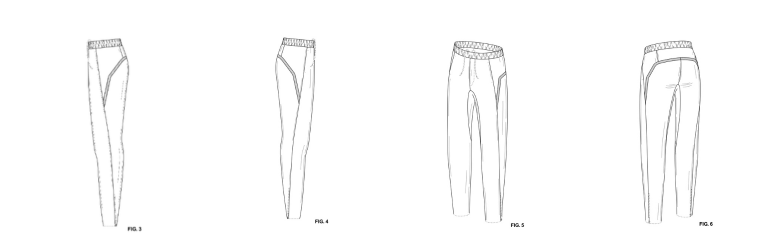
To be registrable, the design must be new. Thus, if a pre-existing, publicly available design is reused, even if it is successfully registered with CIPO, that design will be at risk of being invalidated because it is not new. Once the design is registered, the registration grants an exclusive right to make, sell, import for commercial purposes, offer, or display for sale or rent the registered design, a right that lasts for at least 10 years from registration or, if that date is later, until 15 years after the application was filed. The more distinct your design is from what existed, the larger the scope of the protection will be.
Thus, the designer must create distinctive and innovative garments, but also identify, before marketing, the visual elements that deserve protection. In the fashion industry, this type of protection can be particularly useful, since the value of a garment often lies in its appearance.
For fashion items intended to remain on the market for a long period, registering an industrial design is the most effective way to prevent them from being copied by third parties. This protection varies from country to country. Thus, in the United States, reference is made to a “Design Patent” and, in Europe, to a design. As in the case of patents, the countries must be chosen carefully and registration must be completed. In some states, such as France, protection exists even in the absence of registration.
Industrial design protection does not apply to purely functional features of a garment. In other words, if an element was designed primarily to serve a technical purpose, that utilitarian feature cannot be protected under industrial design law. It should be protectable by patent.
Depending on the case, the same garment or accessory may also benefit from complementary protection under copyright or trademark law.
3. Trademarks: Protecting the distinctive signs of a fashion brand
Trademark law protects the owner of a mark against the use, by a competitor, of a mark likely to create confusion as to the origin of the goods or services.
In practice, a trademark is often what allows consumers to distinguish one product from another on the market. It is often the trademark affixed to a garment that makes it possible to sell a white T-shirt for $150 rather than $30.
A trademark may consist, in particular, of a logo, common or invented words, or even a distinctive colour affixed to a garment, provided that the sign is distinctive and allows the consumer to identify the commercial source of the product.
Trademarks may also take the form of position marks. These are marks in which the location of the sign on the product forms part of what is protected. For example, in Canada Adidas owns a mark consisting of three parallel stripes placed along the sleeve of a jacket. In that registration, the garment itself is not protected. It is shown only to indicate where the stripes are positioned. In other words, what is protected is not simply the presence of stripes, but their precise placement on the garment: 2
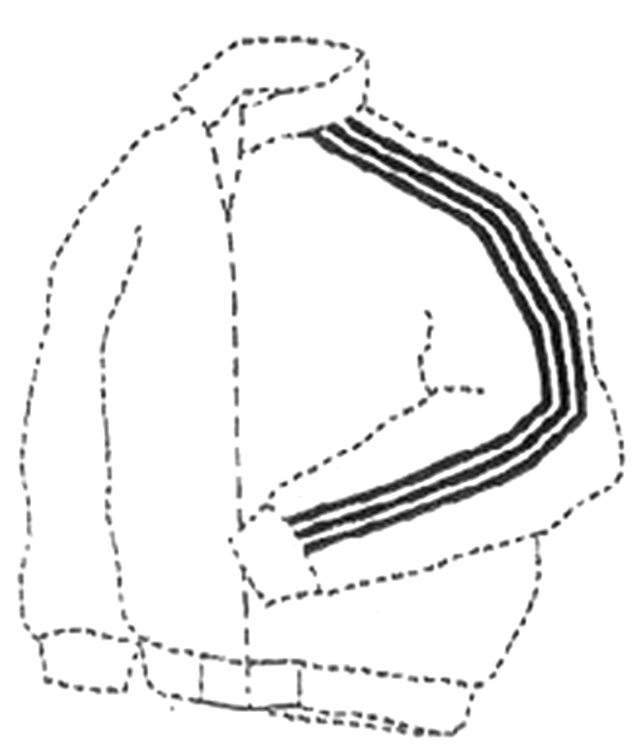
For businesses in the fashion industry, trademarks are often among their most valuable assets. Indeed, they represent the company’s image in the eyes of consumers, support its goodwill, and help preserve the value of its products in the marketplace. It is therefore important for these businesses to understand the scope of their rights in order to prevent confusion, combat counterfeiting, and limit harm to the value of their trademark(s).
In Canada, a trademark may benefit from a certain degree of protection through use alone, even in the absence of registration. However, that protection remains more limited and, in practice, depends in particular on proof of goodwill and a likelihood of confusion in the relevant market. Registration therefore offers significant advantages, since it grants its owner, subject to validity, the exclusive right to use the mark throughout Canada in association with the listed goods and services, as well as more effective remedies against third parties who use a sign likely to create confusion for consumers.
4. Copyright: Protecting original patterns, prints, logos, and decorative elements
In the clothing industry, certain creations may benefit from copyright protection, including logos, patterns, prints, or other original decorative elements.
As a general rule, in Canada, an original work is protected as soon as it is created, without the need for registration. Protection usually lasts for the author’s lifetime and 70 years after death. Even in the absence of registration, the author will have rights. If the creation is made by an employee in the course of employment, the owner of the work will be the employer.
However, copyright has certain lesser-known limits. When the work is a utilitarian article, such as a sweater, a belt, a cap, or a shoe, the Copyright Act may not apply.
Thus, if the work is the design of a sweater and the sweater has been reproduced in more than 50 copies, the copyright owner of the design may prevent reproduction of the design, but may not prevent someone else from making the same sweater under the Act. The design should have been protected as an industrial design or, as some luxury watch companies do, reproduction should have been limited to no more than 50 copies. Needless to say, those watches are outrageously expensive!
This exception does not apply to a logo, a trademark, or works that are simply affixed to a utilitarian article. For example, the owner of the copyright in the works of painter Riopelle may still prevent manufacturers of mugs or T-shirts from selling them, even if rights have been granted to the Guggenheim or the Montreal Museum of Fine Arts.
Conclusion
Creativity alone is not enough in the fashion industry; one must also know how to protect its fruits. Thus, having teams work while keeping protectable features in mind, so as to position the business properly in the market, will support the company’s growth. This strategy will also protect customers against the unpleasant surprises that may result from purchasing a product falsely presented as the original.
What to remember
- A fashion collection may fall under several intellectual property regimes at once: patent, industrial design, trademark, and copyright.
- Timing is crucial: protectable elements must be identified before the launch or disclosure of a new collection.
- Protection must be considered by territory: in Canada, but also in the countries where the products will be sold, manufactured, or copied.
- Canadian Intellectual Property Office, Canadian Industrial Designs Database, LULULEMON ATHLETICA CANADA INC., industrial design registration no 231957.
- Canadian Intellectual Property Office, Canadian Trademarks Database: Canadian trademark registration number: TMA757178, 3-STRIPES JACKET & DESIGN — 1382211.